Jobs AI Cannot Replace (The Honest List)
Let me start with the uncomfortable part.
Nobody can hand you a guaranteed list. Anyone who says "these ten jobs are one hundred percent safe" is guessing, and they will not be around in five years to apologise.
What you can have is something better. A test. Once you understand what AI is actually bad at, you can apply it to any job, including ones that do not exist yet.
So here is the test first, then the list.
The Four Questions That Decide It
Ask these about any job:
- Does it need you to be physically there? Not on a call. Actually present, in a place, dealing with a real object or a real person.
- Does it run on trust built over time? Does someone need to know you before they act on what you say?
- Does someone have to be accountable? When it goes wrong, does a human have to answer for it, sign for it, or be liable for it?
- Is the information messy? Not clean data on a screen, but a half-finished site, an angry customer, a machine making a strange sound.
The more yes answers, the harder that job is to replace.
Notice what is not on this list: how technical the job is, how prestigious it sounds, or how much it pays. Those are the things we usually judge careers by, and they turn out to be the wrong filters.
The Jobs That Pass the Test
Licensed professions where someone signs
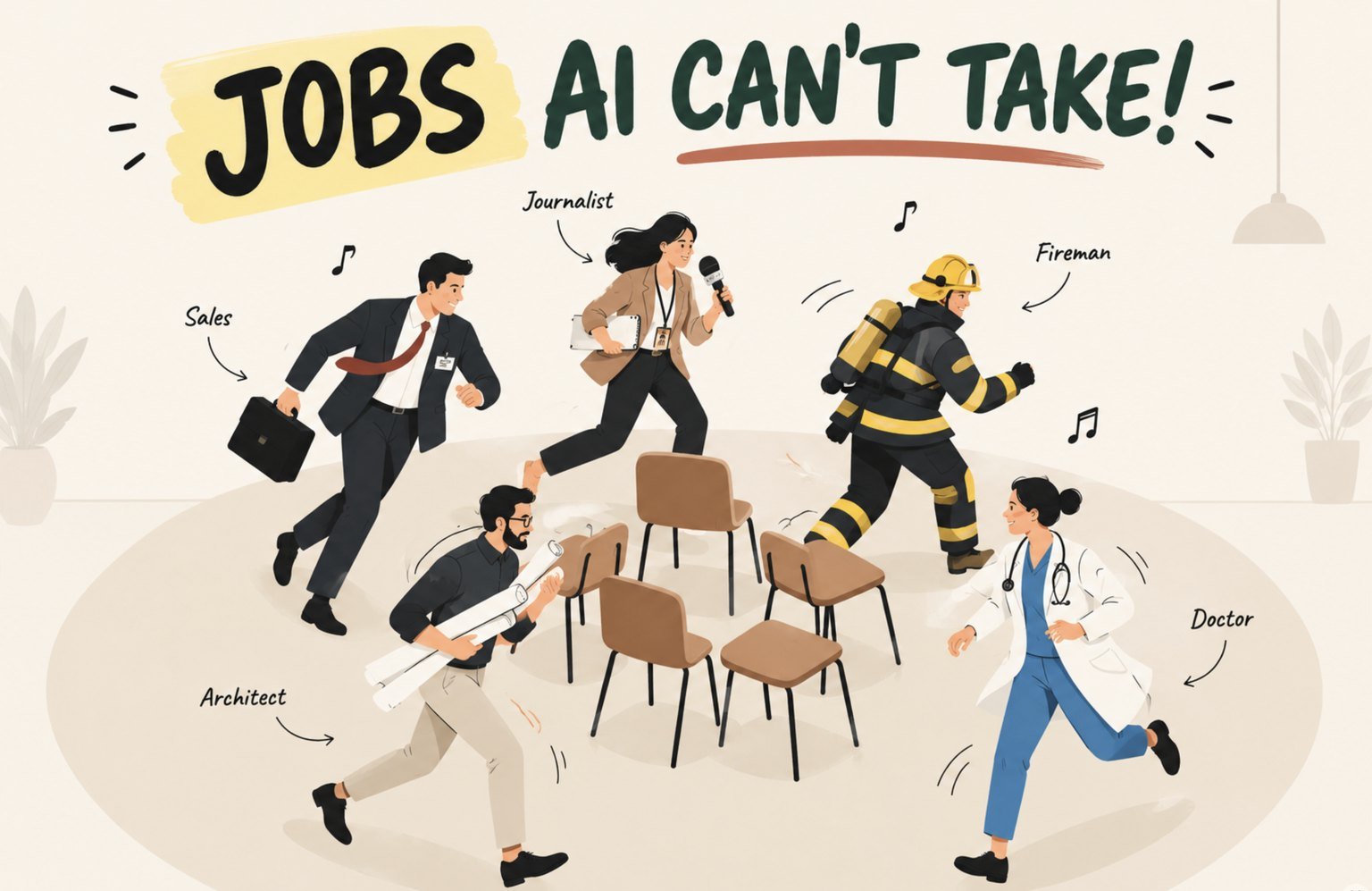
Doctors, surgeons, dentists, chartered accountants, lawyers, architects, structural engineers.
The moat here is not intelligence. AI can already read a scan or a contract clause well. The moat is liability. Somebody has to sign, and you cannot sue software. That protection is legal, not technical, which is exactly why it holds even as AI improves.
Skilled trades and field technical work
Electricians, plumbers, HVAC and refrigeration technicians, solar installers, lift technicians, telecom field engineers, industrial maintenance.
No two sites are identical. The wiring is not where the drawing said it would be. Somebody has to physically get into that space and make a judgment call. These trades are already reporting worker shortages in multiple markets, and India's construction and infrastructure demand is not slowing.
Healthcare beyond diagnosis
Nurses, physiotherapists, paramedics, lab and imaging technicians, elderly care.
AI is genuinely good at diagnosis support. It is nowhere near turning a patient, calming a frightened family, or noticing that something is wrong before the monitor does.
Sales, especially field and B2B
AI will research your prospect, write your email and prepare your deck. It will not sit across a table, read the room, sense hesitation and change its approach mid-sentence.
Selling has always been about trust. Trust is transferred between people, not from a system.
Operations, supply chain and quality
Warehouse operations, logistics coordination, plant supervision, quality inspection, retail store operations.
Things break physically. Trucks are late, stock is damaged, a machine drifts out of tolerance. Somebody has to be standing there deciding what happens next.
Client-facing and account roles
The person a client calls when they are angry. That role exists because of accountability, not information.
In-person teaching and coaching
Especially with young children. AI can tutor. It cannot hold the attention of forty ten-year-olds, notice which child has stopped participating, or make a teenager care.
Skilled hospitality and personal services
Chefs, stylists, trainers, service staff. Physical, sensory, and built on preference and presence.
On-ground judgment roles
Site engineers, surveyors, inspectors, agricultural extension officers, field researchers. The job is to go somewhere and form a view.
What This List Does Not Mean
This is the part most articles leave out, so read it carefully.
- Hardest to replace is not the same as safe. These roles will change. AI will handle the paperwork, the scheduling, the first draft of the report. The work stays, the boring parts of it leave.
- Hard to replace does not mean well paid. Some of these pay very well, some do not. Do not confuse job security with income. They are separate questions and you should ask both.
- Status and safety are inversely related right now. The jobs everyone wants, the air-conditioned desk role with a laptop, are the most crowded and the most exposed. The jobs people quietly avoid have less competition. That is uncomfortable, and it is the single most useful thing in this article.
- Not yet is doing real work in these sentences. Robotics will eventually reach some physical work. It will be slow, and in India capital cost will slow it further. But do not read this list as permanent.
How to Actually Use This
Do not pick a career off this list.
Take whatever you are already considering, and run the four questions on it. Then run them on the specific role, not the industry, because the same industry contains both kinds of work.
An example. "Marketing" is not one answer. A person writing routine social captions on a laptop all day is highly exposed. A person managing a client relationship, running events, and being accountable for a campaign's outcome is not. Same field, opposite exposure.
That distinction is the whole point. Stop asking which industry is safe. Ask what your actual day looks like.
Final Thought
The safest position is not a job title. It is a combination.
Be someone who can use AI well, and whose work also requires showing up, being trusted, and being accountable for the result.
Almost nobody is optimising for the second half right now. That is the opportunity.
Get the next prompt before everyone else
I share practical AI prompts and workflows for getting ahead at work. Subscribe, it's free.